1. What Steel Framing is and how it works
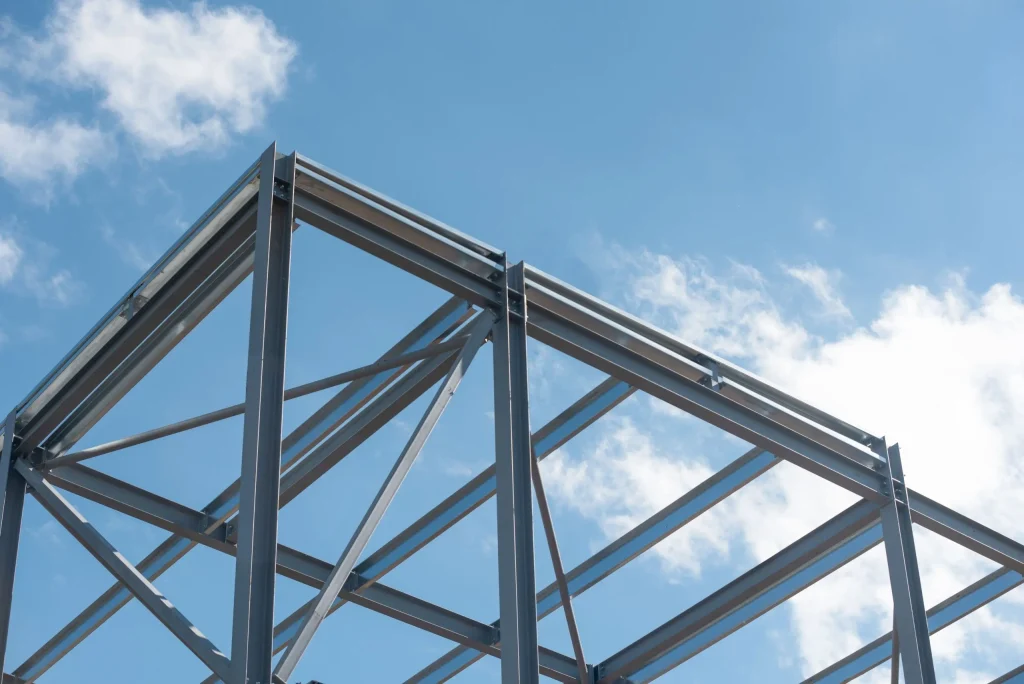
The Steel Framing system from Teczone | Kingspan uses cold-formed galvanized steel profiles as its main structural elements. These profiles are assembled either in the workshop or on site using self-drilling screws, allowing for an orderly and repeatable construction process.
It is a pre-industrialized and lightweight approach, designed to improve efficiency and quality throughout the building process.
The solution is made up of three integrated subsystems: the lightweight profile structure (TZ-Steel Framing); the interior linings, usually with plasterboard; and the “dry” exterior cladding, on which traditional finishes can be applied.
This modularity makes the system compatible with conventional steel or concrete building typologies.
2. Where it adds the most value: typical applications
Although it can be applied to larger buildings, Steel Framing is optimized for constructions of up to four storeys (ground floor + three).
Its most common uses include single-family and low-rise residential housing, offices, educational and healthcare buildings, indoor offices within industrial units, refurbishments, vertical extensions, lightweight roofs, and auxiliary structures.
Because it is compatible with commonly used façade and cladding systems, it integrates easily into mixed projects.
Example project
At Teczone | Kingspan, we highlight a development of 28 single-family homes (4,200 m² built) executed with 104 tonnes of lightweight steel structures, illustrating the scale and type of projects that can be carried out using this system.

3. On-site and operational advantages
Timelines and work organization
The system’s lightweight, pre-industrialized nature promotes component standardization and can help shorten construction times.
Assembly requires no heavy machinery and generally less highly specialized labor.
Because of the reduced structural weight, foundations are usually lighter, simplifying the process and reducing project duration.
Precision and integration of installations
Custom manufacturing (with round or oval punchings available) ensures dimensional accuracy and leaves the structure ready to accommodate building services within walls and floors, without chases.
This approach contributes to a cleaner, better-planned worksite.
4. Sustainable management and logistics of the system
The high structural efficiency allows for reduced steel consumption through optimized sections, while incorporating a significant proportion of recycled material.
Its low weight and optimized palletization reduce transport volume and therefore emissions.
As a dry-construction system, it also lowers water consumption and waste generation on site.
Reduced reliance on heavy equipment further minimizes environmental impact.
5. Range of profiles and standard configurations
Walls (interior and exterior)
Walls are built using a framework of horizontal and vertical profiles: C-shaped studs and U-shaped tracks, forming closed structural panels.
Lintels for openings (doors and windows) are made from two C-profiles forming a closed section.
As a reference, ranges include C-studs with web depths from 50 to 175 mm, flanges from 50 to 75 mm, thicknesses from 0.8 to 1.5 mm, and matching U-tracks.

Floors
Floors follow the same logic: C-beams, U-edge tracks, and cross braces (in C or U), joined with L-shaped connectors.
Depending on spans and loads, reference sections for beams typically range from 175 to 250 mm webs, 50 to 100 mm flanges, and 1.5 to 2.5 mm thicknesses.
Roofs
Flat or pitched roofs use C-beams, U-tracks, and bracing members.
For mono-pitch or gabled non-habitable roofs, trusses or lattices with C-profiles in the chords and diagonals help optimize the structure.
6. Engineering and technical support
The Kingspan | Teczone Technical Department offers comprehensive support: advice on system design, construction details, calculations, and structural sizing.
We also collaborate with external engineering firms specialized in designing or adapting projects to Steel Framing.
This partnership facilitates the integration of the system within existing project teams.
We propose an industrialized building approach based on galvanized steel profiles, ideal for low- and mid-rise projects where precision, lightness, and trade coordination are key.
The combination of profile catalogue, European regulatory compliance, efficient logistics, and technical support makes Steel Framing a system capable of integrating seamlessly with common building materials and finishes — bringing order, efficiency, and design flexibility to the construction process.